Tuesday, 31 March 2015

February 2015 Review - Sydney

Despite the lack of extreme heat, 2015 saw the warmest February of the past four years at Sydney Airport. Cooler summer temperatures towards the end of January carried over into the first few days of the month, but minimums and maximums quickly rose to typical levels soon after. Like January though, the month didn't see a day exceed 35C. It was also rather dry. The monthly total at the Airport was less than half the average.

The averages at Sydney Airport for the past few Februaries can be seen below.
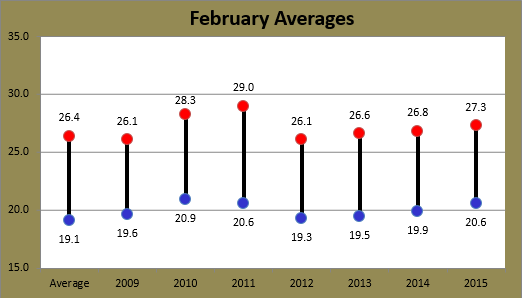
February averages at Sydney Airport for the period 2009-2015 plus the long term average

The average minimum of 20.6C was the equal second highest in the years since 2009. The Bureau of Meteorology recorded the same figure and according to their records, it is the eighth highest since 1940. The average maximum was also the highest of the past four years, but cooler than both 2010 and 2011 and not within the top 10% of figures on record.

The highest temperature of the month was fairly low for February's standards. It reached 33.1C on the 8th. 2013 did, however, record a lower respective figure of 31.0C. The coolest day was a part of the cool summer period extending from January. The 22.7C maximum on February 2 was, however, the equal third highest such figure on record. 

The coldest temperature was 17.6C on February 4. Only 2010 had a figure higher than that since 2009. It is actually the fifth highest such figure on record. The highest minimum came on the 18th. It never went below 22.8C then. This figure was in the middle of those for recent years.

The return to more typical summer temperatures came on February 7 when it rose above 26C for the first time in almost two weeks. The 9th also saw the first minimum above 20C since January 25th. A good run of warm overnight temperatures followed. Of the final 20 days of the month, there were only two minimums below 20C. They were only just below that mark too with figures of 19.6C and 19.5C on the 15th and 25th respectively.

Daily minimums and maximums against rainfall at Sydney Airport for February 2015

Rainfall was far below the long term average of 111.9mm. Despite there being 11 days on which precipitation was recorded at the Airport, the monthly total only reached 44.4mm. The Bureau recorded a total of 48.0mm, putting it as the lowest since 14.4mm was recorded in 2011. More tellingly though, in the 16 Februaries since 2000, 12 of them saw monthly totals exceed 50mm, and 10 exceed 100mm.

The wettest day was February 13. It saw 18.6mm recorded at the Airport. It was part of the longest rain day streak which lasted from February 12 until the 15th and accounted for 21.8mm of the monthly total. Scattered rain days led to a longest dry streak of only six just before the period aforementioned.

Wind gusts were down on figures from the previous two Februaries. February 2 saw the strongest gust of the month, a southerly at 67km/h. This is much lower than the figures of 91km/h and 76km/h from 2013 and 2014. 

The comparatively calm start to the year in January continued during February. There were nine days with a strongest gust at or above 50km/h, much lower than the 15 and 12 occurrences of the two previous years. The calmest day was the 26th when the strongest gust was only 30km/h.

Monday, 30 March 2015

Overdue catch-up on Sydney and Jyväskylä weather

Well it has been quite some time between posts on this blog. This was due to a combination of holidays and lack of motivation, but it's time for me to get back into it.

So, what has been happening with the weather in Sydney and Jyväskylä during the past six weeks? Perhaps surprisingly, the period has only seen a slight shift in weather conditions as the new seasons of winter and summer draw closer.

The change between the middle of February and now can be noticed in different ways between the cities. In Sydney, it's the figures themselves that are the difference. Daily minimums and maximums are slowing dropping, with minimums dropping at a slightly quicker rate, but in Jyväskylä, it's maybe more the melting of snow and longer days, rather than the figures themselves, which, other than a week long period earlier this month, haven't been especially different.

Sydney is first up. In order to catch up with what has been happening, let's have a look at the year so far...

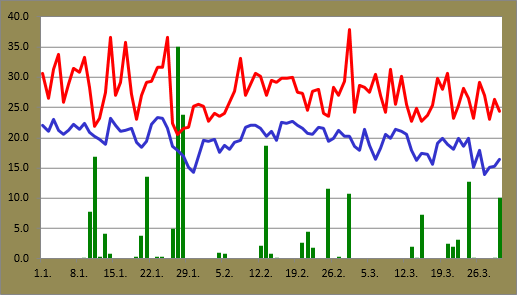
Daily minimums and maximums against rainfall at Sydney Airport for 2015 up until March 30

Since the middle of February daily maximums have comfortably held around 25C and above. A downward trend in the figures is still visible though.

The tall spike is from March 1 when the temperature reached 37.9C at the Airport. This was the hottest temperature at the Airport since the 38.0C reading from November 14 last year. In terms of March extremes, this was the highest March temperature since the 40.3C recording on March 9 in 2004. It was also the seventh highest March reading at the Airport on record. 1983 saw the record of 41.2C.

March 13 saw the lowest maximum during the last six weeks with a top of 22.7C.

The decrease in minimums is a lot clearer in the graph. Since March 12, only one minimum hit the 20C mark. The average minimum for March this year is actually on track to be one of the lowest in recent years. March 27 saw it dipped to 14.0C, the lowest of the year so far, and the second time below 15C. 2010, 2011 and 2014 didn't see a minimum below 15C until April.

Blue skies over Sydney Harbour on March 7

Rainfall totals weren't especially high during the month and a half period. Since 18.6mm fell on February 13, the highest daily total was 12.8mm a week ago on March 24. Including that and today's 10.0mm, there were four days with figures at or above 10mm. Comparing to the same point last year, the cumulative total so far this year is slightly lower; 208.0mm against 219.0mm.

March 1 was probably the highlight day since the middle of February. In addition to the heat, the end of the day saw a very gusty southerly change and storm activity around the Sydney region. A total of 10.8mm was recorded at the Airport along with a strongest gust of 96km/h. This is the third highest strongest daily gust since the start of 2013.

My three week holiday in Australia from February 19 onwards helped me to avoid some rather miserable weather in Jyväskylä.

Daily minimums and maximums against rainfall at Jyväskylä Airport for 2015 up until March 29

Most of the period while I was absent from Finland saw very little change in Jyväskylä. The 16 days from February 20 through to March 7 saw the temperature hover between a low of -1.8C and a high of 3.6C, a difference of only 5.4C.

Luckily for me, my return to the northern hemisphere on March 13 was followed by some of the nicest weather seen in Jyväskylä since last autumn. Clear skies, cold nights and warm days dominated until the 20th. Both March 17 and 18 maxed out at 11.2C. This was easily the earliest time in the year for such a temperature compared to other years since 2009. Other than last year, that kind of maximum wasn't seen until late April.

Ice of Kallavesi, north of Kuopio, on March 26

Daily maximums dipped quickly back closer to zero on the 20th. March 21's maximum of -3.1C was the coldest in over a month. Since my last post on February 17, there have only been three daily maximums below 0C. That's quite a remarkable number comparing to the six previous years. The same 40 day period in 2013 saw 29 days entirely below zero. 2009, 2010, 2011 and 2012 saw 25, 23, 20 and 14 days respectively below the mark. Even last year's warm late winter period saw eight such days.

March 22 saw the lowest temperature at Jyväskylä Airport since February 16 when it dropped to -14.5C, while the 28th's 0.5C reading was the first minimum above zero in almost three weeks.

Other than the exceptionally warm period in the middle of this month, which saw 10 consecutive rain free days, precipitation so far this year has been fairly consistent. As mentioned during the winter, snow depths have been much higher than last year, and while warmer temperatures have melted most of the snow on paths and roads, there is still some snow on grassed and in wooded areas. Snowfall in the past couple of days has also added to the icy remnants of winter's earlier precipitation.

Rain helped to melt the snow further on March 29 but it created muddy puddles in the process

In terms of coming weather, the approaching cooler period for Sydney is becoming more apparent as we head into April as lower minimums and maximums continue. Since 2009, there were only three days in total that managed to hit 30C from March 30 up until the arrival of spring.

In Jyväskylä it appears that spring is on hold, with snow and wet snow, as well as temperatures only a couple of degrees above zero, continuing for the time being. These conditions actually aren't unusual for this of the year, but recent bursts of warmer temperatures have maybe given some false hope for a quick arrival of spring.

Tuesday, 17 February 2015

Cooler in Jyväskylä but change coming, holding steady in Sydney

After a fairly prolonged period of temperatures hovering closer to zero, they dropped below -20C in Jyväskylä on Sunday February 15. This was the first time below the mark since January 21. The 16th dipped slightly lower than what was seen late on Sunday, down to -21.8C. This will most likely be the coldest temperature of the month, already colder than any temperature seen in Jyväskylä during the Februaries of 2009, 2013 and 2014.

Sunday also saw the lowest daily maximum in quite some time. It didn't climb above -6.5C. January 23's -12.6C was the previous recording lower than that. It is the only maximum below -5C this month and, based on current forecasts, it will probably remain that way.

Temperatures have been climbing today though and maximums in the coming week are likely to exceed zero. The next three days could see figures around 3C.  Minimums will also be higher; the current ten day forecast doesn't predict any nights dropping below -5C.

The closing in of spring has been noticeable already in Finland, particularly in the level of sunshine seen in the recent two weeks. Several days have seen cloudless skies and the length of day has also increased above nine hours for first time since late October. Higher temperatures are also helping. Last week's 7.8C maximum from February 11 turned out to be the second highest February temperature ever recorded in Jyväskylä. It was also the earliest date ever for such a high temperature.

Sunset on February 14

February 15 saw clear blue skies over Jyväskylä

In Sydney temperatures have stabilised quite nicely above 25C after a cooler period which started in late January. Today's 29.8C maximum was the 12th consecutive day above the mark. Hotter weather hasn't really been seen though. Of those 12 days, only three exceeded 30C, with February 8's 33.1C top the highest of the month so far.

Minimums have also been quite high. After a two week period extending from January 26 to February 8 that saw daily minimums below 20C, all except one day since the 9th has been entirely above the mark.

Some rain was around last week. Friday February 13 saw the highest falls at the Airport. The 18.6mm is the third highest daily total of the year so far, and the highest this month. An additional 3.2mm across the 12th, 14th and 15th helped the monthly total climb to 23.6mm.

Forecasts suggest more rain in the coming week. There is a medium to high chance of showers, and possibly thunderstorms, running all the way into early next week. Maximum temperatures should remain at similar levels in the high 20s.

Thursday, 12 February 2015

Exceptional warmth in Finland this week

Temperatures in Finland this week climbed to extraordinary highs for this time of year. Temperatures soared above 5C on Tuesday in many parts of the country, while Wednesday saw many locations record temperatures even higher than the day before.

The warmer weather is due to moderate southwesterly winds associated with a high pressure system sitting over Germany. In contrast, locations in the Balkan Region have been experiencing sub-zero temperatures that are much colder than those seen across the Nordic countries.

The all time temperature record in Finland for February wasn't really under threat this week though. The last day of February back in 1943 saw 11.8C recorded at Helsinki's Ilmala (Pasila) weather station. Tuesday February 10 saw a national high of 9.6C in Kaarina, near Turku, while yesterday's top was 9.1C in Porvoo, 50km north east of Helsinki.

In Jyväskylä it didn't quite top 5C on Tuesday, getting to 4.9C, but yesterday saw a high of 7.8C. This was the warmest temperature at Tikkakoski since November 11, three months ago. While daily minimums weren't particularly high in comparison, 0.4C from yesterday was the highest figure this week, these maximums are very unusual for this early in February.

The graph below is a little cluttered, but if we look at maximums in Jyväskylä from January to the end of April since 2009, we can see just how unusual this is. The green line from 2015 clearly sticks out.

Daily maximums at Jyväskylä Airport from January to April for the years 2009-2015
(as of February 11, 2015)

For the years of 2009 through to 2013, it wasn't until April that Jyväskylä first experienced a top temperature above 7.8C. 2009 saw the latest date of April 22, more than two months beyond 2015's mark of February 11. The other year, 2014, had March 12 as its first day.

The warmer weather has been accompanied with a good amount of sunshine too. No precipitation has been recorded at the Airport since Monday the 9th. The high temperatures and lack of further falls have led to the snow depth dropping to 38cm by this evening. Footpaths around the city centre have also either become mini ice skating rinks or very sloshy. FMI released warnings about very dangerous pathways for pedestrians across Central Finland for Tuesday and yesterday. Conditions didn't improve much today, but colder temperatures are expected heading into the weekend.

Monday, 9 February 2015

Sunny and windy in Jyväskylä over the weekend, hotter in Sydney

Some of the strongest winds of the past year were seen in Jyväskylä during the weekend. The average wind speed at Jyväskylä Airport held above 10m/s for around eight hours from a bit before 6am on Sunday morning. Wind gusts were up to 20m/s as well.

Warnings were in place for most of Finland as a strong low pressure system made its way across the lower half of the country in a southeasterly direction. Unsurprisingly, the strongest gusts were seen in coastal areas. Sälgrund, on the western coast near Kaskinen, recorded a gust of 36.3m/s and an average wind speed measurement over 10 minutes of 30.4m/s. Elsewhere, Helsinki-Vantaa Airport recorded a gust at 28.6m/s and a 27.5m/s gust was recorded in Kokemäki.

Daylight hours across the weekend saw bright blue sky and plenty of sun. Friday February 6 through to Sunday all saw good levels of sunshine. This was the first three day period of sun that I can remember since maybe last October.

There was some snow during the nights though. A band of precipitation, also moving in a southeasterly direction, preceded a rise in temperature on Saturday. A total of 2.4mm was recorded at Tikkakoski. Snow depths did touch 50cm at one point yesterday, but strong winds, and the resulting shifting snow, have the depth at 45cm today. Remarkably, of the 40 days so far in 2015, only eight haven't seen any precipitation at Tikkakoski. The most recent dry day, February 5, broke a run of 13 consecutive days of precipitation.

The rise in temperature on Saturday resulted in the warmest recording in almost three weeks. It reached 2.1C, the highest since 2.7C was recorded on January 17. That recording was also higher than any February temperature seen from 2009 to 2012. 2013 and 2014 both saw a top of 5.8C.

Temperatures did drop during the evening of February 7 though. After steadying around -5C for most of yesterday, it dropped further during the evening and the first temperature below -10C in just over two weeks was recorded. The -12.5C low today already puts it below February 2014's lowest temperature of -10.6C.

Sun in Jyväskylä during the afternoon of February 6

In Sydney the run of cooler temperatures finally came to an end over the weekend. Saturday the 7th saw a top of 27.7C at Sydney Airport, ending a 12 day run of daily maximums below 26C.

Sunday was even better. It was a very calm day with a strongest gust at the Airport of only 28km/h. This was the weakest such measurement since the same was seen on October 23 last year. Light northwesterly, and later easterly winds, accompanied a rise in temperature up to 33.1C around 4pm at the Airport. The sun was out in full force too. The Bureau of Meteorology recorded 12.2 hours of sunshine, the highest daily measurement since January 17.

It has been fairly dry in Sydney since those heavy falls on January 27 and 28. Only 1.8mm has been recorded at the Airport since then, 1.0mm on February 4 and the remaining 0.8mm the day after. It could stay dry in the coming couple of days but the chance of showers increases as the weekend draws closer.

Tuesday, 3 February 2015

January 2015 Review - Sydney

It was a very warm January at Sydney Airport in 2015. With a week remaining in the month, the Airport was on track to record the highest average minimum on record. A drop in temperatures, however, which included the coldest January day since 2000, led to the final recording being the seventh warmest on record according to Bureau of Meteorology accounts.

The cooler period also led to the average maximum missing a potential record. In the end it was the fifth highest in the Airport's 76 years of January records. These figures were obviously well above the average and rainfall was also above average.

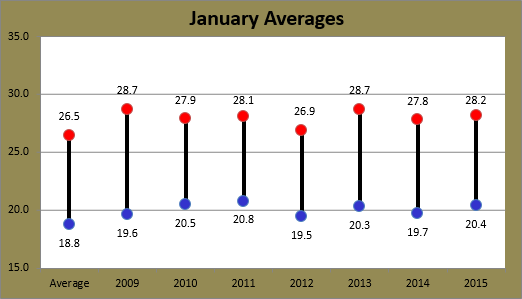
Averages from Januaries between 2009 and 2015 are shown below alongside the long term figure.

January averages at Sydney Airport for the period 2009-2015 plus the long term average

January 14 recorded the highest temperature of the month when it reached 36.7C. Only 2011 and 2012 recorded lower figures since 2009. 2009, 2010 and 2013 all recorded a hottest temperature above 40C. The highest minimum of 23.4C came on the 23rd, just before a drop in temperatures a couple of days later.

The 27th day of the month wasn't warmer than 20.6C. This was the lowest daily maximum for a January day since 2000. The lowest overall temperature was also a little unusual. It dropped to 14.3C on the 30th. In the past 30 years, there have been only seven January minimums lower than that.

The warm average of the month was helped by the number of days above 30C. There were 11 in total, three of which also exceeded 35C. 2009 and 2013 saw 13 and 12 days above 30C. There were also 20 minimums above 20C, 11 of which were the first 11 days of the year. Not once in the Airport's history had it not dropped below 20C by January 11 until this year. The last six days of the month, however, failed to hold above 19C, leaving 2011 and 2013 to remain with higher figures of 23 and 22 minimums above 20C respectively.

Daily minimums and maximums against rainfall at Sydney Airport for January 2015

January rainfall was much higher for Sydney in 2015 compared to 2014. The Airport received 112.6mm during the calendar month, comfortably above the long term average of 93.9mm. The Bureau recorded 112.8mm (0.2mm from December 31). Since 2000, 2015 was the fourth January to exceed 100mm of rain. In 2014 the Airport saw only 11.2mm.

The month saw 14 days of rain. A eight day dry streak ran from the first day of the month until the 8th, but it was followed the longest run of rain days, six from the 9th until the 14th. January 27 recorded the highest daily total with 35.0mm. The 28th, which saw 23.8mm, and the 11th with 16.8mm, were the only other days to record more than 15mm.

Wind strength wasn't especially high during the month. The highest gust of 69km/h was seen on both January 8, a north-northeasterly, and on the 25th, a southerly. May last year was the last month to record a weaker strongest gust. January in 2013 and 2014 recorded higher gusts also. The calmest day was the last day of the month. The strongest gust then was only 31km/h.

January 2015 Review - Jyväskylä

2015 saw a rather mild start to the year in Jyväskylä. This edition of January was the warmest seen since 2008. It wasn't only Jyväskylä that saw warmer temperatures. Everywhere in Finland was above average. The biggest differences were seen in the south where it was between 3C and 4C above average. The differences decreased further north, down to a 0C to 0.5C difference in Lapland. Precipitation was also above average. Many locations recorded almost double the average.

The average minimum and maximums for Januaries at Jyväskylä Airport since 2009 can be seen below.

January averages at Jyväskylä Airport for the period 2009-2015

Both the average minimum and maximum were the highest seen out of the past seven Januaries. The averages weren't too far off those of 2011 and 2013 though. According to the Finnish Meteorological Institute, the average for the month at Jyväskylä Airport was -6.5C, compared to my -6.8C. FMI records put the -6.5C figure as the warmest since 2008, and almost 2C above the 1981-2010 average of -8.3C.

Extremes for the month were seen only on two days. For the second year in a row, New Year's Day was responsible for the warmest temperature of the month as well as the highest minimum. It didn't go below 1.0C then and climbed as high as 3.6C. Since 2009, only 2009 had a warmer respective figure than 3.6C. January 2010 didn't see one recording above zero. 2009 and 2013 had a warmer highest minimum though.

January 6 was the coldest day of the month. It dropped to -24.2C then and was only as warm as -18.5C. The -18.5C recording was the lowest daily maximum since January 18 in 2013. Again, only 2009 saw a warmer overall minimum than January 2014. Every other year saw at least one January day go below -25C.

January 1 was also responsible for the warmest temperature recorded in Finland during the month. It reached an almost balmy 7.5C in Kristiinakaupunki. January 11 saw the lowest overall when it dipped to -39.6C at Utsjoki.

Up and down temperatures from late December continued throughout January. There were four warm periods and three cold periods, as seen in the graph below. Despite having the highest averages of the past seven years, January 2015 recorded more days, eight, with a maximum at -10C or below than 2009, 2011 and 2013. 2012 also saw eight. On the other hand, the recording of 11 days above zero was the highest since 2009.

Daily minimums and maximums against rainfall at Jyväskylä Airport for January 2015

Precipitation was well above average in Jyväskylä during the month. FMI recorded a total of 75mm for Tikkakoski, compared to my 65.9mm. Either way, the 1981-2010 average of 45mm was easily surpassed, as well as 2014's recording of only 15mm. There were 24 days of precipitation. No month in 2014 saw such a high number.

January 2 recorded the highest daily total with 11.6mm. That was also the highest total in two and a half months. Including the 2nd, there were five days that saw more than 5mm recorded. A nine day streak of precipitation from the 23rd to the end of the month was the longest run, while there were two three day streaks of no falls, January 4 to 6 and 20 to 22.

Elsewhere in Finland, the highest monthly total was seen in Tornio. A total of 129mm was recorded there. Tornio also saw the highest daily total when 33.7mm fell on January 29. A three day period around the 29th saw a 30cm increase in snow depth.

While there were some falls on days that exceeded 0C in Jyväskylä, pretty much all precipitation fell as snow. As a result, snow depths were quite good for this time of year. It was 38cm deep by the middle of the month, above the 30cm average. At the same time in 2014, there was only 2cm. By the end of the month this year the depth had gone above 40cm, still a few centimetres above the average.