Thursday, 29 January 2015

2014 Yearly Review - Jyväskylä

Global temperatures for 2014 were the highest on record and it was also rather warm in Finland. The average temperature for the whole country was the second highest on record, below only 1938. It was a year highlighted by a lack of snow in the southern half of the country for the 2013/14 winter, an unusually warm February and March, cold June, but hot July, as well as a mild start to the 2014/15 winter.

In Jyväskylä, the yearly average minimum and maximum of 0.4C and 8.9C were the highest since at least 2009. 2009 to 2013 all recorded an average minimum at 0C or below. 2013's average maximum was also 8.9C, although lower than 2014 if we use two decimal places.

At a monthly level, only January, June and October had both minimum and maximum figures below the 1981-2010 averages. The graph below shows the averages for each month in 2014 while the dotted line represents the long term averages.

Monthly averages at Jyväskylä Airport in 2014 against the 1981-2010 averages

As is typical, July was the warmest month in Jyväskylä in 2014. January took the title for the coldest month though ahead of the usual February. February and March saw figures well above the long term averages. In fact, Jyväskylä saw its second warmest February since at least 1961 in 2014, while March was the equal second warmest on record.

The hottest day of 2014 in Jyväskylä was July 25. It reached 30.3C at Tikkakoski then. Only one other day, July 26 with 30.2C, topped 30C, although two additional days, July 23 and 27, reached 29.9C. Since 2006, 2010 and 2013 were the only other years to record a temperature above 30C. The highest minimum was seen during the same period. July 31 didn't record a temperature lower than 15.3C. This was comparatively low to recent years though, with only 2009 recording a lower respective figure.

The coldest temperature of the year came during the coldest period of the year. It dropped to -27.7C on January 24. Only one other day, January 23, dropped below -25C. Again, only 2009 saw a lower figure with one below -25C. 2011 saw 16 days below the mark and 2010 saw 23. January 23 did, however, record the lowest daily maximum. The -16.1C figure was the warmest such figure in the years since 2009.

The highest temperature seen in Finland in 2014 was at Pori when it reached 32.8C on August 4. This is a fairly average figure. The coldest temperature was recorded in Utsjoki when it dropped to -40.7C on January 20, also a fairly normal figure.

The graph below shows the number of days with a temperature below -20C in Jyväskylä as well as the number of days above 25C. The year saw 35 days above 25C, the highest since at least 2009. 12 days below -20C was the lowest number though, giving support to the recording of the second highest average in Finland on record.

Number of days below -20C and above 25C at Jyväskylä Airport for the years 2009-2014

The next graph shows the daily minimums and maximums up against rainfall. After a couple of weeks at very cold temperatures in January, it is clear to see from the graph that February looks unusually warm. Minimums in March, and even in April, were colder. May saw a cool start to the changing seasons but temperatures exploded upwards on May 19 to 29.3C. Three days earlier on May 16 it was only as warm as 9.1C.

Daily temperatures against rainfall at Jyväskylä Airport in 2014
(Does not include February totals)

Temperatures dropped in the second half of June, but climbed nicely in July. The summer season turned out to be quite a nice one with warm temperatures sticking around until the middle of August. September saw some unusually warm days. Five days of September topped 20C. Septembers from 2009 to 2013 recorded only six such days in total.

October saw a cold end to the month and included some of the lowest October minimums in a decade. Mild weather returned in November though and continued into the early part of December. It wasn't until December 22 that temperatures once again dropped below -10C.

Precipitation in 2014 at Tikkakoski was quite close to the 1981-2010 average. Based on my records, a total of 653.8mm fell. This total included a total from February of 25.0mm as recorded by the Finnish Meteorological Institute. This total was used because the FMI website did not show daily rainfall at Jyväskylä Airport during that month due to a technical fault. FMI records for 2014 show 613mm fell, substantially less than my recording. The average rainfall for a year is 643mm.

Four months of the year recorded above average rainfall, the other eight below. May was the wettest month. It saw 124.6mm, almost three times the long term average. May also included the wettest day of the year. May 26 saw 28.1mm fall. October 19 was the only other day to record a daily total above 25mm. There were six days with totals above 20mm.

Monthly rainfall totals at Jyväskylä Airport in 2014 against the 1981-2010 average

January was the driest month. Only 16.8mm was recorded, just over one-third of the average. Much of that fell with temperatures above zero as well. Warmer days, coupled with dry conditions during colder weather, meant snow depths were among the lowest on record. The snow depth at Tikkakoski never went above 20cm during the whole 2013/14 winter.

The longest streak of precipitation came in December. The 17 days from the 5th to 17th recorded rain or snow. A total of 43.0mm was seen during that time. The longest dry streak was during the peak of the summer. July 17 to 27 saw no rain as temperatures soared above 25C during each day of that period.

In the end, it was a pretty decent year weatherwise for Jyväskylä. The small amount of snow and lack of colder temperatures during the winter months made for some grey and dreary sights, but the summer was especially enjoyable despite the cooler temperatures in June. A warm and mostly dry September also prolonged the warmer season somewhat. Snow at the end of year was welcomed by winter lovers as well.

Tuesday, 27 January 2015

Cool and wet in Sydney, warmer in Jyväskylä

The hot weather seen in Sydney over the weekend, which included a top of 36.6C on January 25, was cut short by a sharp drop in temperatures yesterday. While some cities like Perth and Brisbane saw a sweltering Australia Day, Sydney barely held above 20C. Mild nighttime temperatures helped the Airport record a daily maximum of 22.4C, while the minimum was seen much later as it dipped below 19C around 6pm; only the second time in the 18s this month.

Persistent drizzle arrived from the east to coastal suburbs yesterday afternoon. The cricket match between Australia and India at the Sydney Cricket Ground was abandoned in the evening due to the unrelenting rain. Falls weren't especially high though. Sydney Airport recorded 4.8mm up to midnight. Observatory Hill saw a little more with 13.6mm.

Drizzle increased to heavier showers yesterday evening and during the early hours of today. Showers continued throughout today and rainfall measurements around the city have been much higher. Some totals are the highest seen in a few months. Terrey Hills in Sydney's north has seen the highest total in the region with 92.0mm. Observatory Hill recorded 69.4mm. There was less rain at the Airport but the 35.0mm recording today is still the highest daily total since 86.0mm fell on October 14 last year.

Temperatures have also been rather low today. It reached a top of only 20.6C at the Airport. This is the coldest January maximum seen at the Airport in 15 years. January 7 in 2000 was the previous colder January maximum when it only got as warm as 19.8C. Today's figure is also the lowest maximum since October 21.

Rain has continued throughout the night in Sydney also. The heavier showers should ease in the morning, but there may be a bit of rain around in the coming days. Temperatures will climb a little as well.

After four consecutive days below -10C, temperatures climbed in Jyväskylä on January 24. Since then it hasn't dropped below -3C. It hasn't been above zero either though as temperatures have hovered mostly around -1.5C.

A band of precipitation arrived in Finland from the west early this morning and snow has been falling in Jyväskylä for most of today. A total of 6.1mm has been recorded at Tikkakoski, pushing the snow depth above 40cm for the first time this winter.

Friday, 23 January 2015

Week's weather typical of the season

More typical summer and winter conditions have been seen in the respective cities of Sydney and Jyväskylä this week. After temperatures dropped in Jyväskylä on Monday they have remained below -10C, while in Sydney Tuesday through to today have seen maximums between 27C and 32C at the Airport.

The temperature at Jyväskylä Airport on Monday was as high as -2.2C, but by the evening it had dipped 17.6C to -19.8C. This was the highest difference between minimum and maximum since the same figure was recorded on September 17 last year. Tuesday went even colder, down to -23.6C, and that has held as the coldest temperature of the week. Wednesday January 21 also saw a minimum below -20C, while both Tuesday and Wednesday coincidentally reached -14.1C during the day.

Skies were clear initially at the beginning of the week and some sun shone as well, but clouds have covered Central Finland since Wednesday evening. No snow fell from Monday until this morning, but colder temperatures and no wind helped frost settle on trees and buildings. Light snow fell this morning and further precipitation was recorded during the day, but only 1.9mm was recorded at Tikkakoski.

The lack of wind this week also created an inversion effect around the city area of Jyväskylä, reducing air quality. Inversion occurs when air closer to the ground is colder than the air above it. Without wind or a change in temperature, the air and associated pollutants from cars and factories can't escape upwards and it remains close to the ground, resulting in poor air quality. The local newspaper, Keski-Suomalainen, reported on the event on Wednesday.

Taulumäki in Jyväskylä during the afternoon of January 23

Sydney Airport recorded its second coolest day of January on Monday, but temperatures climbed nicely on Tuesday. A few showers drifted through the city in the early hours of the morning, contributing 3.8mm to the monthly total, and cloud cover was above average throughout the day, but it was still rather warm. It reached 27.1C at the Airport in the afternoon.

January 21 and 22 were a little warmer still, climbing above 29C, and today saw the month's ninth day above 30C by getting to 31.7C. Despite the warmer temperatures on the 21st, early rain dumped 13.6mm at the Airport. This is the second highest daily total of the month so far.

Ambitions to record the highest average minimum on record for a January at Sydney Airport were given a boost yesterday and today. It only went as low as 22.3C yesterday, and 23.4C today. That was after Monday, Tuesday and Wednesday all recorded minimums below 20C. The average now sits at 21.2C with just over a week of January remaining.

Monday, 19 January 2015

Warm weekend, but temperature drops today

Both Sydney and Jyväskylä saw warm weather over the weekend. It was above zero on both days in the central Finnish city, while temperatures along Australia's east coast soared well above 30C on Saturday. Cooler conditions arrived today in both cities, although Jyväskylä's drop will be longer lasting.

Sydney Airport saw its second warmest day of the month on Saturday. Only a few days after a top of 36.7C, the 35.8C maximum was the second maximum above 35C this January, and also the eighth above 30C.

Yesterday was a little cooler, but also more comfortable, as it reached 27.2C. That was despite persistent southerly winds. Weekend minimums were again above 21C, further increasing the likelihood of this January recording the highest average minimum on record.

The southerly winds had more of an impact today. The Airport saw its second lowest daily maximum of the month with a top of 23.0C. Temperatures also dipped below 20C to 19.2C in the late evening. That made today only the third day this month to drop below the mark. The early hours of January 20, however, have seen it drop to 18.4C, the first time below 19C since December 29.

Conditions remained dry at the Airport over the weekend, but a brief shower just before 3am this morning brought the first precipitation since the 14th. A total of 0.4mm was recorded. Showers are currently passing through Sydney and 3.4mm has fallen by 7am.

After rising back above zero in Jyväskylä last Thursday, mild conditions continued over the weekend. Friday evening saw it climb as high as 2.4C. It topped 2.5C just after midnight as well. The warmer temperatures made for some challenging and dangerous conditions for pedestrians and drivers as a few centimetres of packed snow turned to slippery ice.

Saturday held above zero for the whole calendar day for the first time since January 2. It finally dropped below zero at about 2pm Sunday and it has remained that way since then.

A high pressure system is now sitting on the Finnish-Swedish border and is generating colder northeasterly winds across much of Finland. As skies cleared today, temperatures dropped fairly dramatically at Jyväskylä Airport as well from just below -2C at 3am to -17.8C by 10pm. It'll get even colder overnight and the next few days will see temperatures hover close to -20C.

Light snow this morning pushed the current rain day streak to eight. 48.1mm has fallen so far this month. Sun and clear skies are expected this week though with snow possibly not returning until Friday afternoon.

Friday, 16 January 2015

Very warm first half of January for Sydney, up and down in Jyväskylä

The 2015 edition of January has seen a rather warm first half at Sydney Airport. Of the first 15 days, 13 of those surpassed 25C. The same number also remained above 20C.

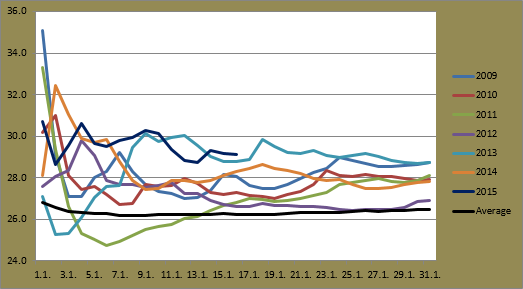
Minimums have been especially warm, as illustrated in the first graph below. While the actual daily figures themselves haven't been anywhere near record levels (2009, 2011 and 2013 recorded higher minimums than this month's highest of 23.2C so far), the consistent run above 20C has helped the average so far stay above 21C.

Bureau of Meteorology methods for recording daily temperatures differ from mine, but their current figure of 21.3C is still well above the highest overall since 1940. For the record, my measurements give an average of 21.4C so far. According to Bureau records, the highest average minimum for a January at the Airport is 20.8C, from both 1991 and 2011. Current forecasts support the idea of this January breaking the record.

Progressive average minimum for January at Sydney Airport for the period 2009-2015 plus the long term average

While all Januaries in the years between 2009 and 2014 saw the average maximum sit below 28C at some point, this January has yet to see that happen. So far seven of the 15 maximums for the month have surpassed 30C. By the same point in the other six years, none had seen that many. 2013 was the next closest with six, while 2012 had only seen one.

Forecasts show the average holding above 28C, but they're likely to be below the figure from 2013 by the 18th. If some hotter days appear towards the end of the month, 2015 could climb to the top of the pile. 1991 also holds the record here with an average of 29.2C.

Progressive average maximum for January at Sydney Airport for the period 2009-2015 plus the long term average

Recent fluctuating temperatures in Jyväskylä, which have included six of the 15 maximums so far above 0C, but also four at or below -10C, have led to a fairly average start for January. The overall average at this point actually sits a little warmer than the 1981-2010 figure; -7.6C compared to -8.3C.

The average minimum has seen movement above and below the -10C mark in the recent week, but it is still holding below the respective figures from 2012, 2013 and 2014. Other than the cold January of 2010, average minimums from the other years since 2009 ended up within a couple of degrees of each other.

Forecasts for the next 10 days will put 2015's line somewhere just below that of 2012. It'll come down to the final week of January before we can see the final average and where it is placed among the recent six years.

Progressive average minimum for January at Jyväskylä Airport for the period 2009-2015

Warm maximums opened January's account this year, but temperatures quickly dropped after a few days. Based on predictions, we could see 2015 as the highest progressive average by January 17. Decreasing temperatures again next week though will force the average back down. If current forecasts for maximums at -15C and below for the end of next week come true, 2015 will place itself somewhere in the middle of the years excluding 2010.

Progressive average maximum for January at Jyväskylä Airport for the period 2009-2015

Wednesday, 14 January 2015

Warmer weather returns

Sydney saw a return to warmer temperatures yesterday. After rain in the early hours of the day, it reached 27.6C a bit after 1:30pm. Some showers returned at around 4:30am this morning, but they cleared quickly enough and temperatures climbed quickly as well. They surpassed the 30C mark already by 10am and Sydney Airport ended up recording its highest temperature in almost two months.

Forecasts yesterday had predicted tops for Sydney of 34C and that was pretty much spot on for Observatory Hill as it reached 34.2C there. Temperatures at the Airport though climbed a little higher to 36.7C. No other station throughout the Sydney region recorded a temperature above that. November 21 was the most recent day to record a higher temperature when it got to 37.0C.

Overnight temperatures were also rather warm. The coolest part of the day was just after midnight, when it was still as warm as 23.2C. That's the highest minimum since a 23.3C recording on February 25 in 2013. With today's minimum, this January has already seen two minimums higher than any figure from 2014.

This morning's showers pushed the consecutive run of rain days at the Airport to six. The monthly total after the first two weeks sits at 30.2mm, almost three times the total from the whole of last January.

Temperatures also climbed in Finland yesterday. Jyväskylä managed to hold below -10C, but locations in the south pushed above zero. It was just over 2.5C at Helsinki's Kumpula station yesterday. Meanwhile in Utsjoki, it was more than 40C colder as it dropped again below -39C, this time to -39.4C.

Even Jyväskylä saw a large difference in temperatures compared to those seen in the south. Clearing skies in the afternoon and evening helped it drop below -20C a bit after 9pm. Kumpula at that time was sitting at 2.6C.

Winds shifted southerly not long after that though and temperatures began a steady climb above -15C. In the 22hrs since 11pm last night when it was still below -16C, it has climbed 15.5C to -0.6C this evening. These milder conditions should hang around for a few days before a slow but steady decline by late Sunday evening heading into next week.

Snow in the playground of Viitaniemi School on January 14

More snow fell in Jyväskylä yesterday morning. A total of 4.6mm yesterday and an additional 3.2mm today has taken the snow depth at Tikkakoski to 38cm. Like Sydney, this is far more than last January. Friday morning could see another dumping of snow too, possibly up to 10cm.

Monday, 12 January 2015

Cold again in Finland, cooler in Sydney also

Temperatures in Jyväskylä have continued their rollercoaster run during the past week. After two days with maximums above zero on January 8 and 9, temperatures dropped sharply over the weekend. It dipped below -15C yesterday to -16.5C. Today has seen a slightly recovery back above -14C, but temperatures should drop later tonight.

Early last week saw Jyväskylä's coldest day in almost two years. January 6 only reached as high as -18.5C. That's colder than any day in 2014 and the coldest since January 18 in 2013.

The up and down nature of temperatures since the middle of December can be seen in the graph below. The relationship between precipitation and the warmer temperatures is also clear.

Fluctuating temperatures alongside precipitation in Jyväskylä in late December 2014 and early January 2015

Locations in Finland's north have seen very cold temperatures the past couple of days. It almost dropped below -40C at Utsjoki in the far north late yesterday. The -39.6C recording there is the coldest so far this winter. The 2013/14 winter's coldest temperature was also seen in Utsjoki, a freezing -40.7C. At the moment, most of Lapland is experiencing consistent temperatures around -35C.

Back in Central Finland, additional snow towards the end of last week helped pushed the snow depth up to, and in some places over, 30cm. This January has already seen far more precipitation than last year. Only 16.8mm fell throughout January 2013, but the first 12 days this time around have already seen 31.9mm.

Warmer temperatures will return once again on Wednesday with tops a couple of degrees below zero. Even milder temperatures, possibly as high as 2C, will arrive on Saturday though before another drop at the start of next week. Snow depths should increase in the coming days as well.

Tuomiojärvi with Laajavuori in the background under the last of the day's light on January 6 
Snow falling in Jyväskylä's city centre on January 8

Sydney's warm run came to an end yesterday. After two weeks with daily maximums above 25C, Sunday January 11 struggled to break the 22C mark. It was a little unexpected though. Forecasts last Friday for yesterday and today predicted a top of 26C for both days. Yesterday's maximum of 21.9C was actually the lowest since late November. Today only reached 23.2C.

The drop in daily maximums has also led to lower minimums. This evening saw the first temperature below 20C at Sydney Airport since the year began. Since January records began in 1940, no other year saw the first 11 days go by without a temperature below 20C at the Airport. 1999, really the only other comparable year, saw only one minimum below 20C in the first 14 days, on January 3. That minimum was also quite high at 19.8C.

The first eight days of 2015 went rain free at Sydney Airport. Friday saw the year's first measurement with 0.2mm though and forecasts at the time predicted the chance of some showers over the weekend. However, more came than expected. Persistent rain arrived in Sydney on Saturday evening. The calendar days of January 10 and 11 recorded respective totals of 7.8mm and 16.8mm; the latter being the highest daily total in almost five weeks. Today added a further 0.4mm to the monthly total and more rain is expected tomorrow.