Monday, 29 September 2014

Hot day in Sydney, windy and slightly warmer in Jyväskylä

Summery weather arrived in Sydney today in slightly unexpected fashion. Forecasts yesterday had predicted tops around 28C for today, but temperatures across the city rose above 33C. Sydney Airport recorded the highest temperature in the Sydney region with a top of 33.5C just after 2:30pm. All other stations topped 30C.

Surprisingly, the Airport's maximum today is the third highest temperature seen this year. Currently the highest maximum for 2014 is the 36.8C recording from January 2. That is the only day to have surpassed 35C so far. Since 2009, only 2012 hadn't seen more than one day above 35C by the end of September. 2011 had seen six. The second hottest day so far this year is February 26 when it reached 34.9C, making today the warmest in just over seven months.

The weekend saw a cooler day on Saturday with a top of only 20.3C at the Airport, but Sunday warmed up to 24.3C. Minimums were comfortably above 10C.

If we look at Bureau of Meteorology records for the Airport, we find that today was actually the 11th warmest September day since the records began in 1939. Tomorrow is forecast to reach a similar temperature as seen today, but a weak southerly change later in the evening will mean that October should start off fairly cool. Maximums of 21C to 23C are then expected for the remainder of the working week.

On the back of a recovery in temperatures late last week, Jyväskylä saw a reasonably comfortable autumn weekend. Maximums for both Saturday and Sunday reached around 13C. Minimums were up on the previous week also. After Friday's 5.1C minimum, Saturday and Sunday both held temperatures above 5C. That was the first three day period above the mark in almost two weeks.

Today has been a bit warmer still. It has gotten above 14C, but appears to have fallen short of 15C. In the years between 2009 and 2013, no days beyond September 30 went above 15C.

Autumn colours in Jyväskylä's suburb of Mäki-Matti on September 29

It was quite windy this afternoon across Central Finland. Gusts at Tikkakoski were recorded around the 15m/s mark (54km/h). These were some of the strongest gusts seen for quite some time. A few isolated showers also rolled west just north of the city. Tikkakoski recorded 0.4mm between 4pm and 5pm.

The weather outlook for Jyväskylä for the next week or so looks to be fairly stable. Partly cloudy, and dry conditions are expected along with maximums between 8C and 12C. Wednesday is currently the only day tipped to dip below zero until early next week.

Friday, 26 September 2014

Storms hit Sydney, more typical autumn weather for Jyväskylä

Sydney Airport recorded its warmest minimum yesterday in almost four months. The warmth seen on Wednesday led to rather warm overnight temperatures as it barely dropped below 18C in the early hours of September 25. A change late in the day, however, dropped the mercury to the daily low of 15.9C. Storms and showers also arrived along with the southerly change.

Wednesday September 24 recorded the second warmest temperature of the month so far. The 25.7C maximum was only the third above 25C this month. Yesterday was still fairly warm also with a top of 24.0C.

The Bureau of Meteorology issued a storm warning for the Sydney region yesterday afternoon as several isolated concentrations of very heavy rain and small hail made their way east across the city.

Despite the menacing appearance of the storm clouds, rainfall totals weren't especially high. The Airport recorded a total of 4.4mm yesterday. In fact, rainfall across the Sydney region was fairly evenly distributed. The highest total, 8.4mm, was seen at Terrey Hills. Penrith in the west, Camden and Sydney Olympic Park each recorded 6.6mm. Observatory Hill only saw 2.0mm. The Airport's total was the highest daily figure in just over two weeks.

Today was much cooler in Sydney. Temperatures at the Airport only reached 18.9C, while Observatory Hill was a little warmer at 21.7C.

The view near Sydney's Central Station on the afternoon of September 25
Source: Imgur

A lightning strike in Sydney's CBD
Source: Imgur

Tuesday's very cold day in Jyväskylä, of which the 3.0C maximum was the lowest seen since April 1, almost five months ago, has given way to a gradual increase in daytime temperatures up until today. September 24's maximum of 5.9C, however, was still the fifth lowest since at least 2009. The 24th also saw another 1.5mm added to the monthly rainfall total.

Yesterday's minimum of -1.6C was the lowest seen this month and the coldest since May 15, but it rose to 8.8C by the late afternoon. Temperatures this morning remained above 5C and they climbed above 12C just after 3pm.

Rain is currently moving in from the west and should reach Jyväskylä around 9pm this evening. Yesterday was dry but 0.2mm was already recorded early this morning at Tikkakoski.

Tuesday, 23 September 2014

Temperatures drop throughout Finland as rain and snow arrives

The cold change that was due to hit Finland arrived late on Sunday night. The change had been predicted since as early as the start of last week and the arrival of northerly winds for the first time in quite a while led to sharp temperature drops throughout the country. Rain and even snow has been seen in the south also.

Jyväskylä saw temperatures hold steady around 10C in the early hours of September 22, but the tripling of wind speed between 4am and 5am saw it drop to around 5C by 8am. While temperatures at this level at that time of the day have been seen in the recent weeks, it was what happened in the following hours that was different, as the graph below shows.

Temperature readings at Jyväskylä Airport from 3pm September 21 until 2:30pm September 23
Source: Finnish Meteorological Institute

In contrast to earlier this September, and actually not since June, temperatures failed to climb during the day. They only dropped further and it was below 4C by 3pm. 

With a maximum of only 3.0C, today was the coldest September day at least in the years since 2009. This is more than 2C lower than the previous lowest. The coldest September day since 2009 had been recorded last year on the 25th. It only reached as high as 5.3C then. The 29th and 30th of 2013 managed tops of 5.4C. Of the other four years (2009-2012), the lowest maximum was 7.2C in 2012, coincidentally recorded also on September 25.

Jyväskylä's chance at recording its driest September on record was quickly washed away in the three hours between 11pm Sunday and 2am Monday. Up until 10pm on September 21, only 1.7mm had been recorded at Tikkakoski since the start of the month. Those three hours, however, accounted for 10.7mm, leaving the all time record of 8.8mm from 1901 safe for now.

Yesterday afternoon saw fairly consistent measurements of just under 1mm per hour from 2pm to 7pm. That led to a total of 13.2mm yesterday, pushing the monthly total to 16.9mm. The 1981-2010 average of 38mm still seems a fair way off, but more rain is forecast later this week.

Jyväskylä also managed to avoid most of the precipitation associated with a trough that had been slowly moving east across Southern Finland. Precipitation mostly fell as rain in Jyväskylä centre during last night and early this morning, but some nearby locations reported snow. Jyväskylä's ski centre, Laajavuori, received some snow this morning as the picture below shows.

Snow on Laajavuori just before 8am on September 23

Eastern Finland, especially, saw heavier snowfall. Temperatures there hovered closer to 0C. Ilomantsi, close to the Russian border, reported a snow depth this evening of 9cm. Meanwhile in nearby Joensuu, the reading was 3cm. Jyväskylä centre received some wet snow from the middle of the afternoon today all the way into the late evening, but the moist and above 0C air meant that any that reached the ground immediately melted.

Wet snow falling in Jyväskylä's Viitaniemi during the afternoon of September 23
More wet snow is expected tonight and temperatures tomorrow shouldn't climb higher than 6C or 7C.

Sunday, 21 September 2014

Cold change coming to Finland, slightly warmer in Sydney

The last remnants of warm temperatures have been seen in Jyväskylä during the past week, but a cold change is imminent. Dry conditions have also continued up until today, but rain is likely to accompany the drop in temperatures.

Yesterday was the first day since September 2 that temperatures didn't climb above 15C at Jyväskylä Airport. It only reached 14.1C, the second coldest maximum for the month so far after September 1's 13.1C. Daily maximum values were fairly consistent though from Monday the 15th until Friday, ranging from 16.1C to 17.9C. These figures have been the highest among those from the five years prior for the same dates.

Despite the warm daytime temperatures, low minimums also continued. The eight day stretch from September 13 to yesterday had minimums ranging between -1.4C and 2.5C with an average of only 0.9C. It's worth keeping in mind that these measurements are from Tikkakoski, as minimums in the city area of Jyväskylä have been hovering more around 5C. However, these are definitely on the lower end of temperatures seen for this time of year since 2009.

Morning fog in Jyväskylä on September 17

This evening has seen a few patches of rain, along with a few small storm cells, move east across Finland. The next 36 hours or so will see temperatures continually drop right down to and below 0C across the southern half of the country. Current forecasts for tomorrow afternoon at 3pm in Jyväskylä have a prediction of only 5C. Sun should return on Tuesday and Wednesday, but it probably won't climb higher than 7C or 8C.


This time of year is arguably the most colourful. Colours in Viitaniemi on September 21

All of the leaves on these trees will fall in the next few weeks

The late arrival of winter to Sydney this year seems to have meant that it has just carried on longer than what has been seen in recent years. Daily maximums this month, as well as minimums, have clearly been on the lower end of the scale for September. Of the years since 2009, only 2010 (the coldest of the five previous years) saw comparable figures.

Since the 26.5C seen on September 11, no day has passed the 25C barrier. September 1 is the only other day to pass that mark so far this month. In addition to that, of the past four days, only one managed to get above 20C. Yesterday's minimum of 8.7C also equalled the month's lowest, set on the 2nd.

Forecasts for the coming week are a little more promising. All days up until September 28 have a predicted top above 20C. However, the highest of those is only 24C for both the 24th and 25th.

Tuesday, 16 September 2014

Contrasting first halves of September for Sydney and Jyväskylä

The first half of September has seen one city begin in cold fashion, the other warm. Things changed quickly though for the first city, with cold weather making way for rather warm temperatures for this time of year, while the other recorded some its coldest September temperatures in quite a few years. If we made a guess of which city we thought was which based only on the seasons and how temperatures should be climbing or falling, we would be wrong.

The average progression graphs below show an unusual mirror. Sydney was the city that started off warm with the second highest September 1 maximum in the past six years. Jyväskylä, on the other hand, saw the coldest September 1 maximum since 2009.

Minimums at Sydney Airport so far this September have been quite low. The highest daily minimum has been 14.8C, which was only recorded today. In the years between 2009 and 2013, only 2011 hadn't recorded a minimum higher than that by September 16.

As with other years, forecasts show the 2014 average minimum to stabilise over the coming week. It'll probably end up somewhere around the 2011 figure, perhaps slightly higher.

Progressive average minimum for September at Sydney Airport for the period 2009-2014 plus the long term average

Other than the cold start to September in 2012, it's clear to see from the progressive average maximum graph below that daily maximums from 2014 have been unusually low so far this month. As mentioned in a previous post, Sydney Airport recorded three consecutive September days below 16C for the first time since 1995. September 8, 9 and 10 helped to increase the average by 1.8C though. The average has somewhat stabilised since then, increasing only slightly in the past couple of days.

Bureau of Meteorology forecasts up until September 23 show the average maximum holding steady alongside the long term average. The long term average maximum for September is 20.6C. If 2014 records the same value or lower, it will be the coldest since 1997. A couple of days in the high 20s towards the end of the month, something almost expected for Sydney during September, will change that though.

Progressive average maximum for September at Sydney Airport for the period 2009-2014 plus the long term average

The minimum progression graph for Jyväskylä shows the average to be the lowest after 16 days of the month. Clear skies and dry conditions associated with recent high pressure systems over Finland have led to some rather cold overnight temperatures in the past few days. The past four minimums have measured between -1.4C (September 16) and 1.7C (September 13) leading to a noticeable dip in the average. While it's not the lowest September temperature since 2009, the -1.4C measurement from this morning is the earliest date after summer for the first recording below -1C.

Current forecasts show the average minimum for this September to close the month as the coldest since at least 2009.

Progressive average minimum for September at Jyväskylä Airport for the period 2009-2014

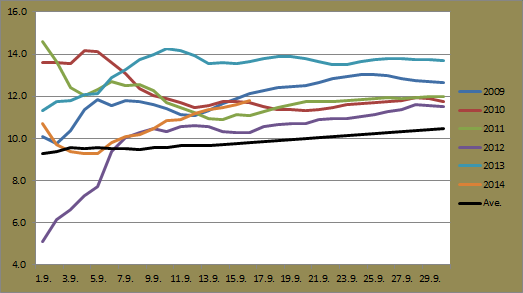
After the first two days, which didn't climb above 14.3C, Jyväskylä has seen exceptional autumn warmth this September, especially considering the cold end to August. Only figures from 2013 rival this year, and the 2014 figure sits more than 4C higher than that of 2012. 

Temperatures will drop over the next week and based on current forecasts, we're likely to see the final average maximum end up as the second highest figure, somewhere between the 2009 and 2013 figures.

Progressive average maximum for September at Jyväskylä Airport for the period 2009-2014
Something else to point out for Jyväskylä so far this September is that it has been exceptionally dry. After 16 days of the month, only 1.6mm has been recorded at Tikkakoski. The 1981-2010 monthly average is 55mm and September 2012 saw 101mm recorded. The record low for Jyväskylä is 8.8mm, from more than 100 years ago in 1901. No significant falls are forecast in the next 10 days either.

Friday, 12 September 2014

Temperatures drop after a warm few days

Warmer spring temperatures finally arrived in Sydney on Tuesday. It reached 24.2C at Sydney Airport during Tuesday afternoon, the warmest temperature in over a week. Unfortunately, as predicted, rain made an unwelcome return on Wednesday. The Airport saw 5.6mm recorded, with most of it falling around 6am. Temperatures still managed to get above 23C during the day though.

Yesterday and today have remained dry. It's been a long time coming, but that makes it the first instance of two consecutive days without rain since August 14 and 15.

In addition to the dry conditions, yesterday also continued the spring warmth from the two days prior. This time temperatures at the Airport climbed to 26.5C. May 22 and 23 also recorded a daily maximum at that figure, but to find a temperature higher you have to go back to the 30.1C recording from April 24, which is just over four and a half months ago.

A gradual southerly change occurred late yesterday evening, dropping temperatures. As a result, today has been much cooler. In fact, today's maximum of 16.8C is almost 10C colder than yesterday. The 9.7C difference makes it the third biggest drop between two consecutive days so far this year. The highest in 2014 is the 12.9C difference between the 34.9C top from February 26 and the 27th's 22.0C.

Another odd statistic from today was that the 2.5C difference between the low of 14.3C and the maximum of 16.8C is the smallest fluctuation this year and lowest since November 18 last year.

Despite early fog on a few mornings in Jyväskylä this week, the weather has been quite good. As my September 7 post mentioned, Tikkakoski only saw six September days above 20C between 2009 and 2013. Tuesday the 9th made it this September's fifth occurrence. This, however, should be the last day above 20C for this year. Wednesday and Thursday came very close also, getting to 19.4C and 19.8C respectively. The current average maximum for the month of 18.8C is the highest respective figure since 2009. It also sits 5C higher than that of 2012.

Like Sydney, Jyväskylä saw a drop in temperatures today. It barely got above 15C this afternoon making it the coldest day in almost a week and a half. Minimums have also been down - the previous two days have had figures just above 5C. This is fairly normal for this time of year though.

Dry weather also continued up until today. Other than a measly 0.1mm recorded on September 2, no other rain had been seen at Jyväskylä Airport until 4pm this afternoon. Tikkakoski registered a total of 1.5mm between 4pm and 7pm. Current forecasts suggest the monthly rainfall total will be well below average by the time September ends. Current forecasts don't predict any rain until September 21.

Wednesday, 10 September 2014

A look at the summer of 2014

Typically, summer in the Northern Hemisphere includes the months of June, July and August. For the sake of this post and analysis I've included May as well. The reason behind this is that May in Finland is very capable of producing warm days similar to those seen during the normal summer months. As some sort of support to that statement, Jyväskylä's highest temperature in 2009 was actually recorded in May.

The summer of 2014 in Jyväskylä was very warm. However, the overall figures and monthly averages between May and August don't necessarily tell the whole story.

May started off very cold. Then temperatures suddenly climbed to record highs, before quickly dropping just before the end of month. The average maximum for May was the lowest since at least 2009 and FMI figures put May 2014 very close to the 1981-2010 average.

After the first three days of June, temperatures briefly returned to those seen in mid-May. Just as quickly as they had arrived, they disappeared. The second half of June was cold, wet and generally quite miserable. FMI put June 2014 as the coldest since 2004.

Then came July. The first two days struggled to 15C, but real summer weather arrived on the 3rd. July 7, 8 and 9 each climbed above 26C. The rest of month saw beautiful, warm summer temperatures with any rainfall only associated with storm activity. The month wasn't quite as warm as that seen in 2010, but it was the sixth warmest since at least 1961.

August continued July's good run of warm temperatures, but they fell away quickly after the first two weeks. The average maximum from the first 15 days was 8.5C higher than that of the final 16. The early warmth helped August 2014 claim its place as the eighth warmest since at least 1961.

It was a summer of extremes; there were distinct periods of unusually cold temperatures along with periods of warm, and at times record, highs. The graph below shows the daily minimums and maximums at Jyväskylä Airport from the start of May until the end of August. The specific cold and warm segments of the summer are quite clear. For some comparison, the dotted line represents the averages from daily figures between 2009 and 2013.

Daily minimums and maximums at Jyväskylä Airport between May and August 2014.
Dotted line represents daily averages from 2009-2013.

If we go deeper in looking at how the summer of 2014 compared to previous years, we can turn to the number of days with minimums above and below 10C. The graph below shows this.
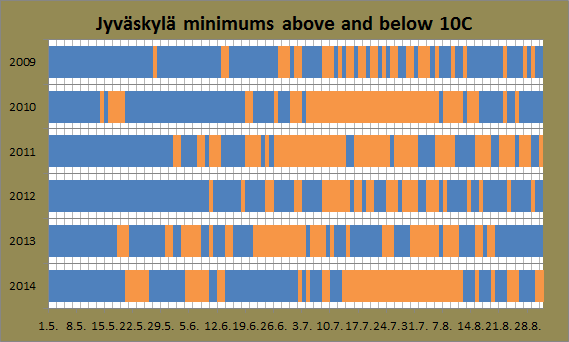
Jyväskylä minimums between May and August in the years between 2009 and 2014.
Blue represents minimums below 10C while orange represents minimums above 10C.

This year was quite similar to 2010. There was an early block of days in May and an extended period from July into August where temperatures remained above 10C. In 2010's case, this period lasted 33 days. 2014 recorded 30 consecutive days above 10C. 2009 and 2012's lack of consecutive days above 10C is quite clear also.

Jyväskylä maximums between May and August in the years between 2009 and 2014.
Blue represents maximums below 20C while orange represents maximums above 20C.
If we look at maximums above 20C, 2014's distinct warm and cold periods clearly stand out. Unlike 2011, for example, where temperatures fluctuated a lot more, 2014 saw consistent runs of days above or below 20C.

It's also interesting to see how many days with a maximum above 20C that also climbed above 25C. 2009 and 2012, especially, had the highest number of days that failed to convert 20C days into 'hellepäivät'.

Jyväskylä maximums between May and August in the years between 2009 and 2014.
Blue represents maximums below 25C while orange represents maximums above 25C.

I think this graph in particular is a great indicator of whether the summer was a good one. 2009 and 2012 were clearly not great summers, recording only 2 and 8 days above 25C respectively. On the other hand, 2010, 2014 and even 2011 and 2013 were rather good summers. There plenty of days above 25C, and they occurred at different times during the summer.

Looking at the graph, you can't help but once again compare 2014 to 2010. Both had good runs of days above 25C. This time 2014 recorded the higher number of consecutive days, a total of 12 in July. Another run of 10 days above 25C was also seen. 2010's highest streak was 10.

Some statistics for summer 2014 include:

  • Highest temperature at Jyväskylä Airport of 30.3C on July 25. (Finland's highest temperature was 32.8C in Pori on August 4)
  • Lowest temperature at Jyväskylä Airport of -6.4C on May 7.
  • Wettest day was May 26 with 28.1mm.
  • The overall high from each month from May to August was above 28C, something not seen in the years between 2009 and 2013.
  • The weather stations of Helsinki Kumpula, Kouvola Utti and Hattula Lepaa all broke the record for the longest streak of days above 25C. With recordings dating back to 1959, the record had been 22 from the summer of 2003. Now it stands at 26.

In the end, 2014's summer was an exceptionally good one. Despite some of the cold temperatures seen, warm days were fairly evenly spread and July and early August were especially good. Now we head towards the cold of winter...